
Introduction
The elevator industry can be confusing and difficult to understand. We wish to simply and demystify elevator ownership and purchases. To accomplish that goal we have put together a list of elevator terms that you can reference when you need them or look over before you are making important elevator decisions.
ADA – Americans with Disabilities Act
A U.S. federal law that prohibits discrimination against individuals with disabilities and establishes accessibility requirements for buildings, including elevators.
ANSI – American National Standards Institute
A private, not-for-profit organization dedicated to supporting the U.S. voluntary standards and conformity assessment system. ANSI enhances the global competitiveness of U.S. business and quality of life by providing a framework for fair standards development and safeguarding their integrity.
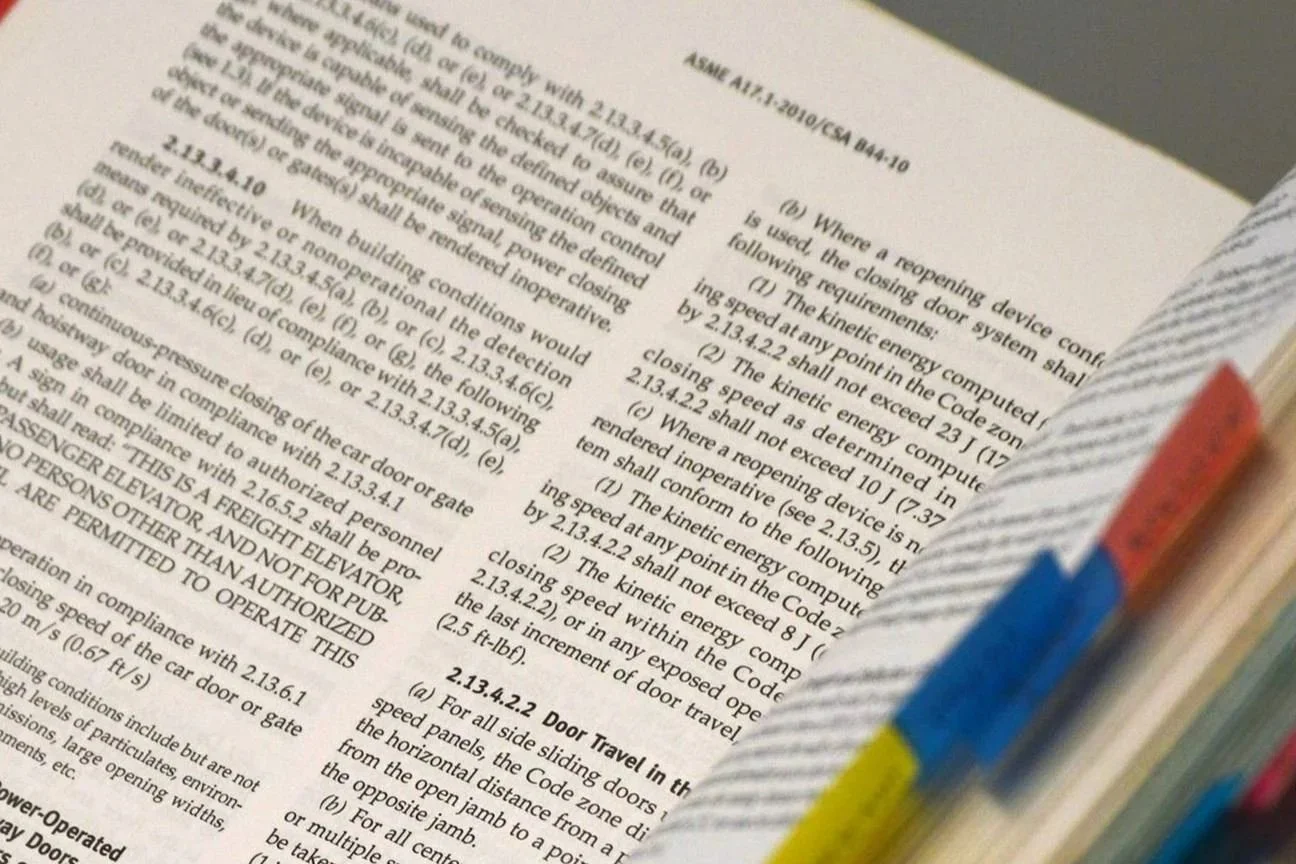
ASME – American Society of Mechanical Engineers
An organization made up of more than 4,700 volunteers, including engineers, scientists, and government officials, who contribute technical expertise to protect public safety while reflecting best business practices. ASME publishes the A17.1 Safety Code for Elevators and Escalators.
Automatic Operation
The starting of the elevator car in response to momentary actuation of operating devices at the landing and/or inside the car. Once activated, the car will stop automatically at the landing and the doors will open.
Capacity
The maximum weight that can be accommodated by the elevator.
Car (Cab)
The passenger or freight compartment that travels within the hoistway.
Car Operating Panel (COP), Car Station
A panel mounted in the car containing controls such as floor pushbuttons, alarm, emergency stop, and other required operating switches.
Car-Top Inspection Station
A control panel on top of the elevator car which, when activated, removes the car from normal service and allows it to run at inspection speed from the car top only.
Controller
An electrical panel that governs the elevator’s operation, performing computer-based control functions.
Counterweight
Added weight on a traction elevator that balances the car to improve efficiency and reduce motor load.
Destination Dispatch
An advanced control system where passengers select their floor before entering the elevator, and the system groups riders traveling to similar floors to improve efficiency.
Drive System
The mechanism used to move the elevator. Common types include hydraulic, roped hydraulic, traction, and machine-room-less (MRL).
Dumbwaiter
A small freight elevator designed to carry objects rather than passengers.
Existing Installation
A term used when an elevator is already in place, typically referring to modernization or replacement projects.
FPM (Feet Per Minute)
The speed at which the elevator travels.
Final Limit
One of two mechanically operated switches mounted in the hoistway (top and bottom) that cuts off power to the drive motor if the car travels beyond a preset distance past a terminal landing.
Freight Elevator
An elevator designed primarily for carrying goods rather than passengers.
Governor
A mechanical speed control device that monitors car speed (typically in the downward direction). If overspeed occurs, the governor activates safeties to stop the car.
Gurney-Compliant Elevator
An elevator designed to accommodate a medical stretcher, meeting specific dimensional requirements outlined by code.
Holeless Hydraulic Elevator
A type of hydraulic elevator that uses pistons mounted beside the car within the hoistway and does not require below-ground drilling.
Hoist Ropes
Steel cables used in traction and roped hydraulic elevators to raise and lower the car.
Hoistway
The shaft in which the elevator travels.
Hoistway Door
The door at each landing that provides access to the elevator.
Hydraulic Elevator
An elevator powered by a hydraulic piston that pushes the car upward using fluid pressure. Commonly used in low- to mid-rise buildings (typically 2–5 stories).
In-Ground Hydraulic Elevator
A hydraulic system that uses a piston installed in a drilled hole below the pit floor.
Interlock
A safety device that physically locks the hoistway door and sends an electrical signal allowing the car to run only when the door is properly secured.
Landing
A floor level served by the elevator.
Landing Zone
A zone extending from 18 inches below to 18 inches above a landing.
Layout Drawing
A scaled mechanical drawing showing plan views and elevations of the hoistway and machine room, indicating space requirements and component locations.
Leveling
Automatic movement of the elevator within the leveling zone to align the car floor with the landing sill.
Leveling Zone
The limited distance above or below a landing within which the elevator may move to achieve level alignment.
Load
The capacity rating in pounds that an elevator is designed to safely handle.
LU/LA (Limited Use / Limited Application)
A smaller commercial elevator permitted under specific code allowances, typically used in low-rise buildings with lower traffic demands.
Machine Room
The room housing the elevator’s power and control equipment (unless using MRL design).
Machine Room-Less (MRL) Elevator
An elevator design that houses the drive equipment within the hoistway, eliminating the need for a separate machine room.
Modernization
Upgrading or replacing components of an existing elevator system to improve performance, safety, and code compliance.
Operation – Constant Pressure
The elevator moves only while pressure is maintained on the control button. Common in LU/LA systems.
Operation – Momentary Pressure (Full Automatic)
Accepts one call at a time and dispatches the car automatically.
Operation – Selective Collective
Standard passenger operation where the elevator answers calls in sequence based on direction of travel.
Operation – Single Automatic
One call at a time; the elevator answers and then waits for the next command.
Overhead
The space above the top landing required for elevator components and safety clearance.
Overhead Machine
The drive unit that applies the energy needed to raise and lower the elevator.
Parking
A feature that returns the elevator to a designated landing after all calls are answered.
Pit
The recessed area below the lowest landing that provides clearance for support components and leveling.
Personnel Elevator
An elevator used to carry trained and authorized personnel only.
Precision Landing™
The ability to position the elevator car within .8 mm throughout the hoistway.
Rail (Guide Rail)
Structural steel members fastened to the hoistway walls to guide the car and counterweight.
Rated Load
The maximum load the elevator is designed to carry at rated speed.
Rated Speed
The specified operating speed of the elevator in the up direction with rated load.
Roped Hydraulic Elevator (Roped Hydro)
A hydraulic elevator that uses a piston combined with ropes and sheaves to move the car. This configuration allows greater travel distances than standard hydraulic systems.
Seismic Switch
An earthquake safety device that disables elevator operation during significant seismic activity.
Sheave
A grooved wheel over which hoist ropes pass in traction and roped hydraulic systems.
Simplex Operation
A controller operating a single elevator car.
Traction Elevator
An elevator moved by steel ropes passing over a drive sheave. Commonly used in mid- and high-rise buildings.
Traction Drive
An electric machine that moves the elevator car using friction between hoist ropes and a drive sheave.
Vertical Transportation
Any conveyance system that moves people or materials vertically within a building.
