If the hydraulic elevator is the dependable work truck—built for reliability, steady performance, and day-in, day-out service—then the traction elevator is the high-speed passenger train. Designed for efficiency, speed, and long-distance travel, traction elevators excel where hydraulic systems begin to reach their limits. At Georgia Lift Solutions, we work with both systems regularly and help clients choose the right solution based on building height, usage, and long-term performance needs. While hydraulic elevators are lifted by pistons, traction elevators move using ropes and pulleys.
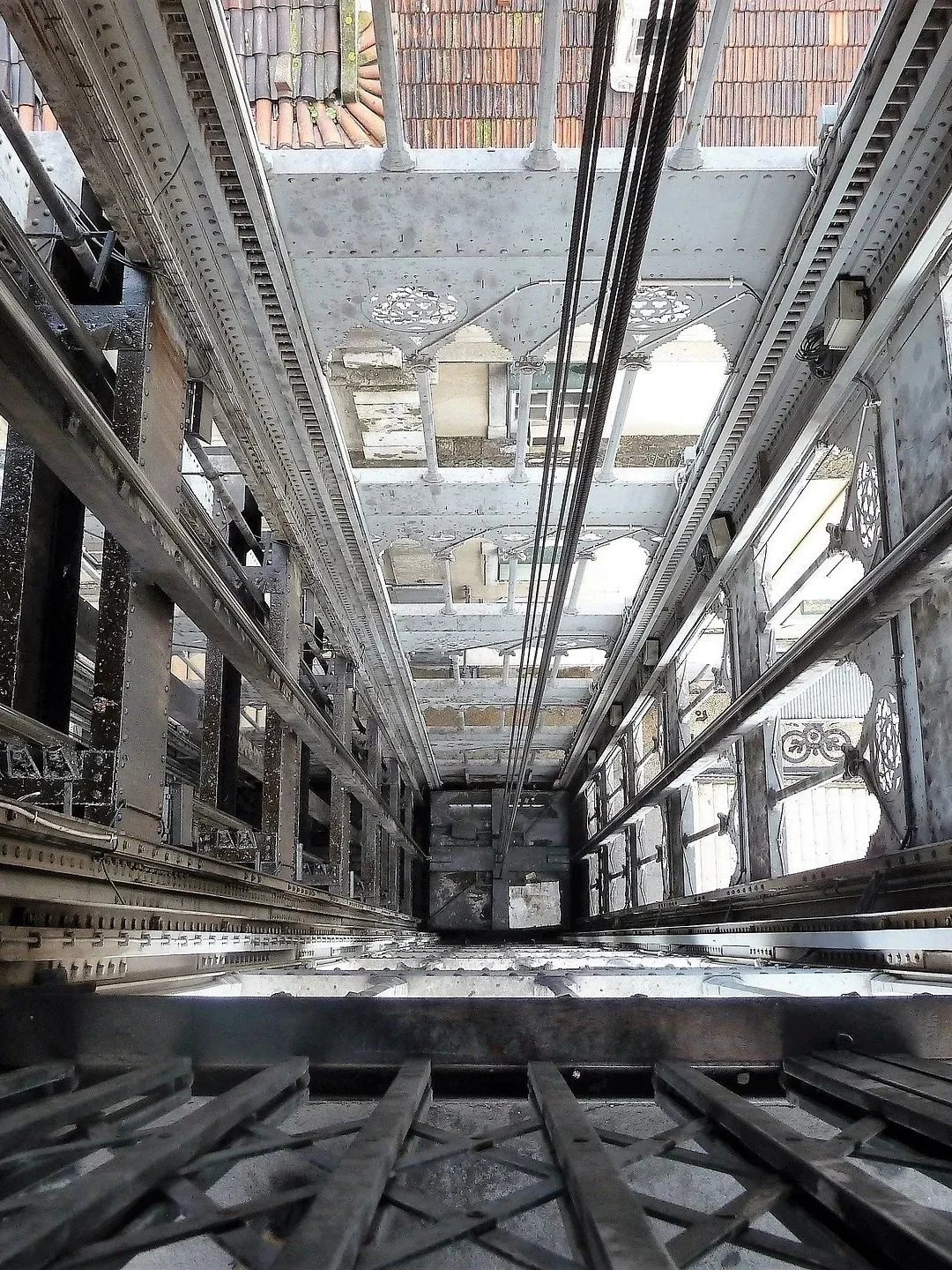
If you remember your sixth-grade science class, the basic concept will feel familiar. The elevator car travels up and down the hoistway on steel wire ropes that pass over a grooved wheel called a sheave (essentially a heavy-duty pulley) mounted at the top of the shaft. In its simplest configuration, one end of the rope is attached to the elevator car and the other to a stack of counterweights. These counterweights balance the load, allowing the motor to turn the sheave efficiently and move passengers smoothly between floors—a principle Georgia Lift Solutions technicians see in action every day.
If you ever have the opportunity to observe a traction elevator from the top of the car (with a certified professional, of course), you’ll notice there isn’t just one rope and one pulley. There are multiple ropes and often multiple sheaves. This redundancy is critical for safety—if one rope were to fail, the others remain in place to support the car. Efficiency also plays a role. As basic physics teaches us, adding pulleys reduces the effort required to lift a load. Multiple ropes increase safety, while multiple sheaves improve performance and energy efficiency—key considerations in modern elevator design and maintenance.
Traction elevators fall into three primary categories: Geared Traction, Gearless Traction, and Machine Roomless (MRL).
Geared traction elevators use a motor located in a machine room above the hoistway, connected to a gearbox that turns the sheave. The gearbox amplifies the motor’s torque, allowing a smaller motor to perform the work. Speed matters when you’re waiting on an elevator, and geared traction systems can reach speeds of up to 500 feet per minute (fpm). By comparison, hydraulic elevators typically top out around 200 fpm. Geared traction elevators can also serve buildings up to approximately 250 feet tall, whereas hydraulic systems become significantly more costly beyond about 60 feet—a key reason Georgia Lift Solutions often recommends traction systems for mid-rise buildings.
Gearless traction elevators push performance even further. In these systems, the sheave is mounted directly to the motor shaft, eliminating the gearbox entirely. This design allows for greater speed, smoother operation, and longer travel distances. Gearless traction elevators are the standard choice for high-rise buildings, capable of speeds up to 2,000 fpm and travel distances approaching 2,000 feet. These are the systems that quietly and efficiently move thousands of people every day in major towers.
Whether geared or gearless, traditional traction elevators require a machine room at the top of the shaft, and their motors can account for up to 10% of a building’s total energy consumption. As energy efficiency became a greater priority, the industry responded with a smarter alternative: the Machine Roomless Elevator (MRL).
MRLs are traction elevators and look much like gearless systems, complete with ropes and sheaves—until you reach the top of the hoistway. Instead of a large machine room, MRLs use a compact motor and sheave installed within the overhead space, positioned off to the side above the counterweights. Advances in motor efficiency and miniaturization make this possible. The controller is typically housed in a small cabinet outside the hoistway near the top landing. At Georgia Lift Solutions, MRLs are a popular recommendation for mid-rise buildings because they offer speeds and travel distances similar to geared traction elevators while using less energy and eliminating the need for a dedicated machine room.
And if you ever find yourself standing on top of a traction elevator car with a Georgia Lift Solutions–certified technician, one thing will be immediately clear: the ropes or cables running beneath your feet are doing the heavy lifting—quietly, efficiently, and safely, just as they were designed to do.
