
If you assume all elevators run on cables, you’re in good company. Most people picture traction elevators—the familiar cable-and-rope systems that have been moving passengers since at least the third century BC. While early versions were crude, the roped elevator took a dramatic leap forward in 1852 when Elisha Otis famously cut the cable on a suspended platform at the New York World’s Fair. The platform didn’t fall, thanks to a newly invented roped safety device. That moment marked the birth of the modern elevator.
Since then, tens of thousands of traction elevators have been installed, cementing them as the mental image most of us have when we think about how elevators work. Hollywood has helped, too. Movies love the suspense of fraying cables, dramatic music, sparks, fire, and an elevator dangling fifty stories above disaster—usually accompanied by a long goodbye or a steady stream of one-liners that make elevator professionals wince.
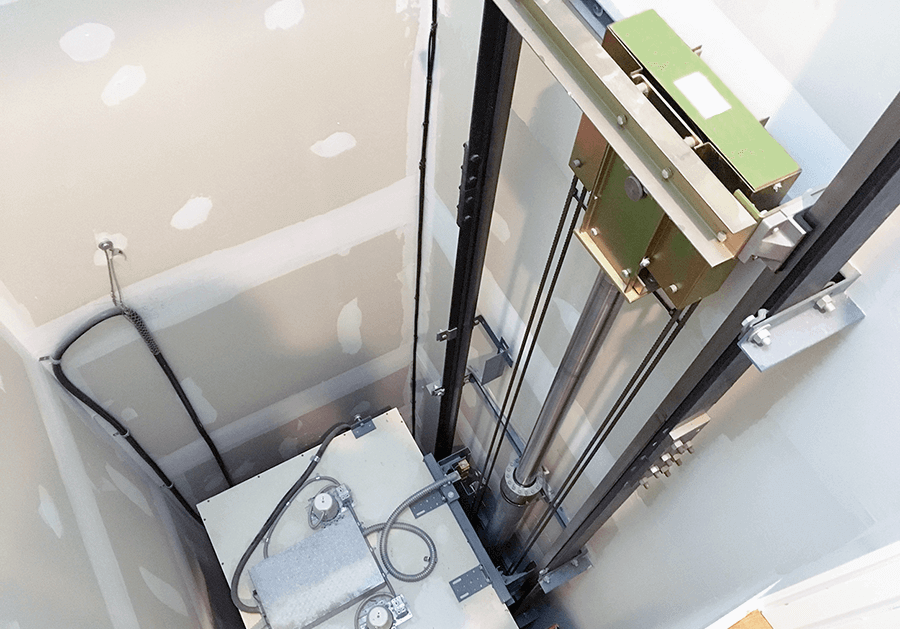
But if you ever get the chance to look at the top of an elevator car with a certified elevator technician in a two- to five-story building, the scene will be far less cinematic. There will be no flames, no swelling soundtrack—and no ropes or cables. That’s because in low-rise buildings, hydraulic elevators are often the smarter choice.
Hydraulic elevators actually predate widespread passenger traction elevators. They first appeared in the early 1800s for freight and limited passenger use, originally powered by water rather than oil. Water pressure pushed the car up, and releasing the water allowed it to descend. By the 1970s, modern oil-hydraulic systems became widespread, and today roughly 70% of elevators installed in new low-rise construction are hydraulic. They’re typically less expensive to install and require less maintenance over time due to having fewer moving parts.
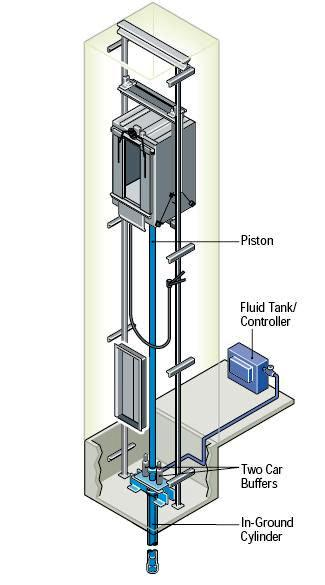
Early oil-hydraulic elevators relied on a single piston, or jack, installed directly beneath the elevator car and embedded in the ground. A power unit—essentially a large tank containing a pump, motor, and valve—forces oil into the jack to raise the car and allows the oil to return to the tank to lower it.
The challenge is that the jack must be as long as the total vertical travel of the elevator. As buildings get taller, the jack (and the hole it sits in) must get deeper, quickly becoming impractical. Two-stage telescoping jacks can reduce the required hole depth by half, and three- or four-stage jacks can extend travel even further. Eventually, though, the cost outweighs the benefit, and traction elevators make more economic sense.
Hydraulic technology advanced again in the 1970s with the development of holeless hydraulic systems. These use a pair of jacks mounted on either side of the elevator car instead of a single jack beneath it. Rather than pushing from below, the jacks attach to the car sling and lift from the sides. For travel beyond about 15–16 feet, holeless jacks become too tall, so they also telescope in multiple stages. As with in-ground jacks, there’s a point where increased complexity and cost make traction elevators the better option.
Now further advancement has changed the elevator landscape once again with the arrival and acceptance of machine-room-less MRL hydraulic elevator. Now instead of a separate room for the tank, motors, and controller they are all housed within the hoistway. This space saver can make more sense especially when square footage is a top priority. Apartment complexes and hotels are very interested in MRL options.
That’s really all there is to hydraulic elevator drive systems: one or two jacks connected by piping to a power unit that raises and lowers the car. Other components exist in the hoistway and on the car, but those are common to all elevator types. Traction elevators, which we’ll cover later, are more complex—but they can also go higher and faster.
One final piece of advice: if you ever get to look at the top of your elevator car with a certified elevator mechanic, don’t be disappointed if you don’t see ropes or fire. Be relieved.
